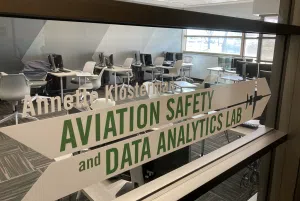
The Annette Klosterman Aviation Safety and Data Analytics Lab at UND. (UND archival photo)
(By James Higgins. UND Today) – Approximately 185,000 people have died in civilian aviation accidents since the advent of powered flight over a century ago. However, over the past five years among the U.S. airlines, the risk of dying was almost zero. In fact, you have a much better chance of winning most lotteries than you do of dying as a passenger on a U.S. air carrier.
How did flying get so safe? And can we apply the hard-earned safety lessons from aviation to artificial intelligence?
When humanity introduces a new paradigm-shifting technology and that technology is rapidly adopted globally, the future consequences are unknown and often collectively feared. The introduction of powered flight in 1903 by the Wright brothers was no exception. There were many objections to this new technology, including religious, political and technical concerns.
It wasn’t long after powered flight was introduced that the first airplane accident occurred – and by not long I mean the same day. It happened on the Wright brothers’ fourth flight. The first person to die in an aircraft accident was killed five years later in 1908. Since then, there have been over 89,000 airplane accidents globally.
I’m a researcher who studies air travel safety, and I see how today’s AI industry resembles the early – and decidedly less safe – years of the aviation industry.





FOLLOW US FOR INSTANT UPDATES!


